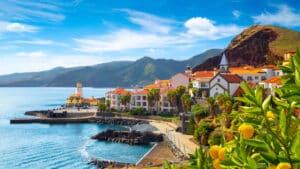
What a family actually does in the weeks after the plane lands, in the order it needs doing.
The keys turn in a door in Cascais. Boxes line the hallway, the kettle is still packed somewhere, and your youngest wants to know how far it is to the sea. This is the point where a moving to Portugal checklist stops being a tidy planning spreadsheet and becomes the thing you live by, hour to hour, for the next three months. The visa got you here. The settling in is a separate job, and it starts the moment you arrive.
Portugal’s Golden Visa asks remarkably little of you in person. Seven days a year in the country is enough to keep the residency live, which is one reason the programme suits families who travel for work or want a foothold in Europe without uprooting everything at once. Many of the families we work with choose to do more than the minimum. They come to live, properly, with school runs and a family doctor and a car that needs a Portuguese number plate. For them, arrival is where the real planning begins.
| The families who settle most smoothly treat the first 90 days as a sequence, not a scramble. |
What should a moving to Portugal checklist cover first?
Start with the documents that everything else depends on. In your first weeks, secure a Portuguese tax number (NIF), open a local bank account, confirm your AIMA residency appointment, and register a home address. Schools, doctors and your driving licence come next. Each step makes the next one possible.
There is a logic to the order. Almost nothing in Portugal happens without a NIF, the número de identificação fiscal, also called the número de contribuinte. You need it to sign a lease, switch on the electricity, buy a phone contract, and register with a doctor. Get this one early and the rest of the list moves. Leave it, and you hit the same wall again and again.
Week one: the paperwork that opens every door
Your NIF can be arranged before you land or in person once you arrive, often at a Finanças office or through a lawyer. With it in hand, a bank account becomes straightforward. A local account matters more than people expect, because most Portuguese bills run on direct debit, and most day-to-day payments run through Multibanco, the national ATM and payments network.
Then there is residency itself. Since October 2023, immigration has been handled by AIMA, the Agency for Integration, Migration and Asylum, which replaced the former SEF. The changeover brought a long appointment backlog, so the date for your biometrics is not something to leave floating. If you came in through the Portugal Golden Visa, your lawyer usually holds these dates for you. Confirm them anyway. Diaries slip.
Utilities, internet and the first home bills
Electricity and gas come from suppliers such as EDP and Galp, water is usually billed by the local câmara, and the internet is split between a handful of providers including MEO, NOS and Vodafone. Each contract asks for your NIF and, in most cases, a Portuguese bank account or MB WAY, the mobile payment app linked to Multibanco.
Here is the small, pleasant surprise. Portugal’s payments system is genuinely ahead of much of Europe. From one Multibanco machine you can pay a tax bill, top up a phone, settle a utility, and split a dinner with friends through MB WAY, all without a counter or a queue. People who have wrestled with banking elsewhere tend to notice within a week.
Set up direct debits early. A missed bill in a new country is a tedious thing to untangle. Keep the first month’s paperwork in one folder, paper or digital, and you save yourself a lot of cross-referencing later.
Schools, and the first weeks in Portugal for children
For most families, this is the part that decides how the first weeks in Portugal actually feel. Settle the children and the rest tends to follow.
Portugal runs two systems side by side. Public schools are free and teach in Portuguese, with placement handled through the local agrupamento de escolas tied to your address. International and private schools teach in English or a bilingual mix and tend to fill quickly, so the better-known ones keep waiting lists well ahead of term.
The names families ask about most cluster around Lisbon and the coast. St Julian’s School in Carcavelos, the oldest British school in the country. Carlucci American International School of Lisbon, up near Sintra. St Dominic’s International School in São Domingos de Rana. Down in the Algarve, Nobel International School draws families settling around Lagoa and the western beaches. None of this is a recommendation, only a map of where people tend to start looking. Our region-by-region read sets these areas out in more detail if you are still choosing where to settle.
A practical note. Apply before you arrive if you can, or in your very first week if you cannot. Places in the popular schools go fast, and a deposit often holds a seat while your paperwork catches up.
Doctors, health cover and the número de utente
Once you have an address and a NIF, you can register with the public health service, the Serviço Nacional de Saúde, known as the SNS. The number you are given, the número de utente, is what every clinic and hospital asks for (idealista, January 2026). You register in person at the centro de saúde that covers your parish, your freguesia, bringing your NIF, proof of address and proof of legal residence, which can be your residence permit or your AIMA appointment confirmation.
You cannot simply pick the health centre you like the look of. It has to be the one for your area. Turn up at the wrong one and you are likely to be sent home, politely, to find the right desk.
Public care in Portugal is well regarded and very affordable, though waiting lists in the cities can be long. Many families pair their SNS registration with private cover for faster appointments in English. That choice is yours to weigh, and worth pricing early, because the quotes vary widely by age and by region. Our guide to healthcare in Portugal for expats walks through how the two systems fit together.
Your driving licence and the first 90 days
If you plan to drive, the clock starts the day your residence is issued. The rules split by where your licence comes from, and Portugal’s road authority, the IMT, handles all of it.
An EU or EEA licence stays valid, but you are expected to register it with the IMT within 60 days of taking up residence. A non-EU licence is different. You can usually drive on it for the first 90 days, during which you are meant to lodge your exchange application. After that window, the foreign licence stops being valid for driving here, even while the exchange is processed.
Whether you sit a test depends on your country. Portugal swaps licences without an exam where a reciprocity agreement exists, and asks for theory or practical tests where it does not. The United States has no national agreement, though some individual states do, so American families often check their home state first. A medical certificate from a Portuguese doctor is usually part of the file.
The honest tip here is dull but useful. Diarise the date your residence is issued, then count forwards. Ninety days passes faster than you think when the boxes are still half unpacked.
Settling in Portugal at your own pace
Somewhere around week six, the admin thins out and ordinary life takes over. This is the quieter half of settling in Portugal, and it rewards a slower hand.
A few things help. Learn the greetings first. A warm “bom dia” in the bakery, an “obrigado” at the till, and doors open that no form ever could. You do not need fluent Portuguese to feel at home, though a little goes a surprisingly long way, and the language matters later if citizenship is ever on your mind.
Expect a different tempo. Offices close for lunch. Plenty of small businesses shut for much of August, when the country heads to the coast, and the family who tries to sort their utilities in the second week of that month learns this the hard way. The pace is not a flaw to fix. It is part of what drew you here. For families arriving in their fifties and beyond, our guide to retiring in Portugal covers the slower questions worth thinking through once the initial admin is behind you.
Give it a season. The first 90 days are mostly logistics. The months after are where Portugal starts to feel less like a destination and more like an address.
A move like this is rarely about the visa alone. The residence card is the permission. The settling in, the school gate you start to recognise, the café that knows your order, that is the actual life you came for. The first 90 days are busy, sometimes maddening, and then one morning the checklist is mostly ticked and you are simply living somewhere new.
That is the part worth getting right, and it is worth not rushing.
If you are still in the research stage, mapping the move before you commit to anything, that is exactly the right time to get the sequence clear. Our founding team has guided more than 150 families through moves like this one, and we are happy to talk through how the steps fit together for Portugal, with no pressure to decide. You can see how we guide families from first enquiry to arrival, or simply get in touch when you are ready.
Elite Golden Visa provides immigration consultancy services. We do not provide financial or legal advice. All legal services are delivered by independent, qualified immigration lawyers. All investment decisions should be made with independent financial advice.