Portugal sits among the safest countries on earth again this year, and for families choosing a European base, what that safety feels like up close matters more than the ranking itself.
In June 2026, the Institute for Economics and Peace published its annual Global Peace Index. Portugal placed seventh out of 163 countries. For a family weighing where to build a European base, that one number tends to lead somewhere more personal: is Portugal safe to actually live in, day to day, with children in tow? The ranking is a starting point. The life behind it is the real answer.
This piece looks at both. Where Portugal sits on the global map of safety, and what that safety, the climate, and the wider quality of life mean once you’ve unpacked the boxes.
You will also be interested in learning why Americans are leaving the US, and why Portugal is always mentioned.
| For families, Portugal’s safety is less about one good ranking and more about a decade of staying near the top. |
Where Portugal sits among the safest countries in Europe
The 2026 Global Peace Index ranks 163 countries and territories, covering almost the entire world’s population. Portugal came seventh. Within Europe, only a few countries placed higher, and Western and Central Europe remained the most peaceful region on the planet, home to seven of the world’s ten most peaceful countries (Institute for Economics and Peace, Global Peace Index 2026).
To read the ranking properly, it helps to know what feeds it. The index weighs 23 separate indicators, from violent crime and incarceration rates to political stability and relations with neighbouring states. It isn’t a measure of how a place feels on a warm afternoon. It’s a detailed read on how a society holds together under pressure, which is a far harder thing to fake.
Portugal’s score hasn’t wobbled much for years. The country first broke into the global top ten in 2015, climbed as high as second place in 2017, and has stayed near the top since (Institute for Economics and Peace). That’s a long run of stability.
For a family, the European context is the part worth holding onto. You’re not really choosing Portugal over Iceland. You’re usually weighing it against the places you already know well, and on the measures that track everyday safety, Portugal sits ahead of many larger and wealthier neighbours. That’s not nothing when you’re deciding where your children will grow up.
Is Portugal safe for families?
Yes. Portugal ranks among the safest countries in the world, seventh of 163 nations in the 2026 Global Peace Index (Institute for Economics and Peace, June 2026). For families, that means low violent crime, stable public institutions, and streets and parks where children can move around with a degree of freedom many parents thought they’d lost.
The freedom point is the one families tend to notice first. In much of Portugal, children walk to school, play in public squares, and hop on the bus without the low hum of worry that shadows daily life in a lot of other places.
Around Cascais and Carcavelos, just west of Lisbon, long-established international schools like St. Julian’s have taught British and Portuguese pupils side by side for decades, and they’re often where relocating families first put down roots. It’s a common refrain among parents who move there. The adjustment they didn’t expect was how quickly their children started doing things on their own. Our region-by-region read covers the areas families most often shortlist.
No country is crime-free, and Portugal has the usual big-city annoyances. Pickpocketing on a packed Lisbon tram is real, and the historic tram 28 is a known hotspot for it. Violent crime, though, stays low by European standards, and that’s the figure that shapes how a childhood actually feels.
What quality of life in Portugal actually looks like
Safety rarely travels alone. The same things that make a country peaceful, stable institutions, social trust, a sense of fairness in daily life, tend to make it a pleasant place to wake up in.
In the InterNations Expat Insider 2025 survey, which gathered the views of more than 10,000 people living abroad, Portugal placed 17th of 46 destinations overall (InterNations, September 2025). Mid-table, on the face of it. The detail is kinder than the headline, because people living in Portugal consistently rate the climate, the ease of getting around, and the warmth of locals well above the global average. The drag on the score is bureaucracy and the job market, not the texture of daily life.
International Living went further on the safety question specifically. Its 2026 “Safest Places to Retire” index placed Portugal first for safety among the destinations it tracks (International Living, 2026). That index leans towards older movers, but the underlying point carries across ages. A country that feels secure for a retiring couple tends to feel secure for a family with young children too. Our read on retiring in Portugal over 55 covers the practical side of that for older readers.
Cost belongs in this conversation, and honestly so. Portugal remains more affordable than much of Western Europe, though Lisbon and the Algarve have grown noticeably pricier as more people have arrived. It’s still a place where a good quality of life in Portugal doesn’t demand a London or Zurich budget, but the gap has narrowed.
Sunshine, the sea, and an outdoor childhood
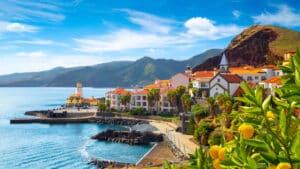
Then there’s the weather, which does more for daily life than any index can capture. The Algarve records around 3,000 hours of sunshine a year, among the highest figures anywhere in Europe (long-term climate records, 1990 to 2020). Lisbon isn’t far behind, at roughly 2,800 hours.
What that buys you is an outdoor life, and it reshapes the week without you quite deciding it should. Children’s birthday parties happen on the beach in October. Saturday football runs all year. Dinner spills onto a terrace for most of the calendar, and the rhythm of family life moves outdoors in a way that’s genuinely hard to give up once you’ve had a year of it.
There’s a practical layer too. Portugal flies hundreds of Blue Flags each summer, the international mark of clean, well-managed beaches and safe bathing water (Blue Flag programme, 2025). For a coastal family, that’s reassurance you can stand on, not a slogan.
Why safety matters most as a long-term decision
Here’s the thing about a safety ranking. One good year is pleasant. A decade of them is a pattern you can actually plan around. Portugal has held a top-ten place in the Global Peace Index for most of the last ten years (Institute for Economics and Peace), and that consistency is what makes it credible as a long-term home rather than a good holiday.
For the families we work with, often thinking a generation ahead, that stability is usually the deciding factor. A home that’s safe this year is welcome. A country that’s been safe for a decade, with institutions that don’t lurch from crisis to crisis, is something you can build a family’s future around with some confidence. Once the decision is closer, our moving to Portugal checklist walks through what the first 90 days on the ground actually involve.
This is also where Portugal’s residency options enter the picture. For non-EU families, the country’s Golden Visa offers eligibility to apply for residency through a qualifying investment, and in time, eligibility to apply for citizenship after ten years of legal residence (Lei Orgânica n.º 1/2026). We cover the key benefits and the practical steps of the residency process in detail elsewhere. The safety, though, is often what makes families look seriously at the rest.
A safer base, not just a safer statistic
A safe country isn’t only about crime figures on a chart. It’s about whether you can picture your children growing up there. Walking to school. Swimming through a long summer. Building a life that feels both freer and steadier than the one you left behind. Portugal’s rankings are the evidence. The daily life behind them is the reason families stay.
If you’re early in weighing up Portugal for your family, our guide to why Portugal is a useful next read. When you’re ready to talk specifics, you can get in touch with us, with no obligation, and we’ll walk you through how the process actually works.
Elite Golden Visa provides immigration consultancy services. We do not provide financial or legal advice. All legal services are delivered by independent, qualified immigration lawyers. All investment decisions should be made with independent financial advice.